


How Does Wireless Charging Work? The Complete Guide

Powering an iPhone without a plug relies on an unseen magnetic field shared between two copper coils. This simple link allows power to travel through materials like solid wood and real leather. Knowing how this works is the first step toward building a faster and neater home charging setup.
Just how does wireless charging work for your iPhone or other Apple devices? The process uses electromagnetic induction to move power through the air without any metal pins or wires. A charging station contains a copper coil that creates a small magnetic field using alternating current. When you place your phone on the stand, a second coil inside the device catches this field. Then, it turns that energy back into power for the battery. This transfer only works over very short distances, usually about five to eight millimeters. Modern systems like MagSafe use magnets to snap these two coils into the perfect spot. This alignment is vital because even a small miss can make the charger slow or create too much heat. This technology makes charging simple and keeps your desk free of messy cables.
Upgrade your charging setup with NYTSTND premium wireless stations today.
You may wonder what makes this possible without a cable. The answer lies in a technology known as electromagnetic induction.
What Is Wireless Charging?
Wireless charging is a way to power your gear without using a plug or cord. Most people use this feature to charge phones, watches, and headphones by placing them on a flat pad. This method is common for Apple users who want a tidy space while managing multiple devices. When you learn how does wireless charging work, you will see it relies on hidden fields to move power. This tech helps you keep your nightstand or desk free from extra wires.
The Science of Induction
The tech behind this is called electromagnetic induction. It uses two copper coils to move power. One coil is in the charging pad and the other is in your device. The charger turns power into a magnetic field that reaches out from the pad. As noted by the Wireless Power Consortium, the power transfer relies on this field to bridge the gap between charger and device. Once the receiver coil picks up the field, it converts that energy back into electrical current to charge your battery.
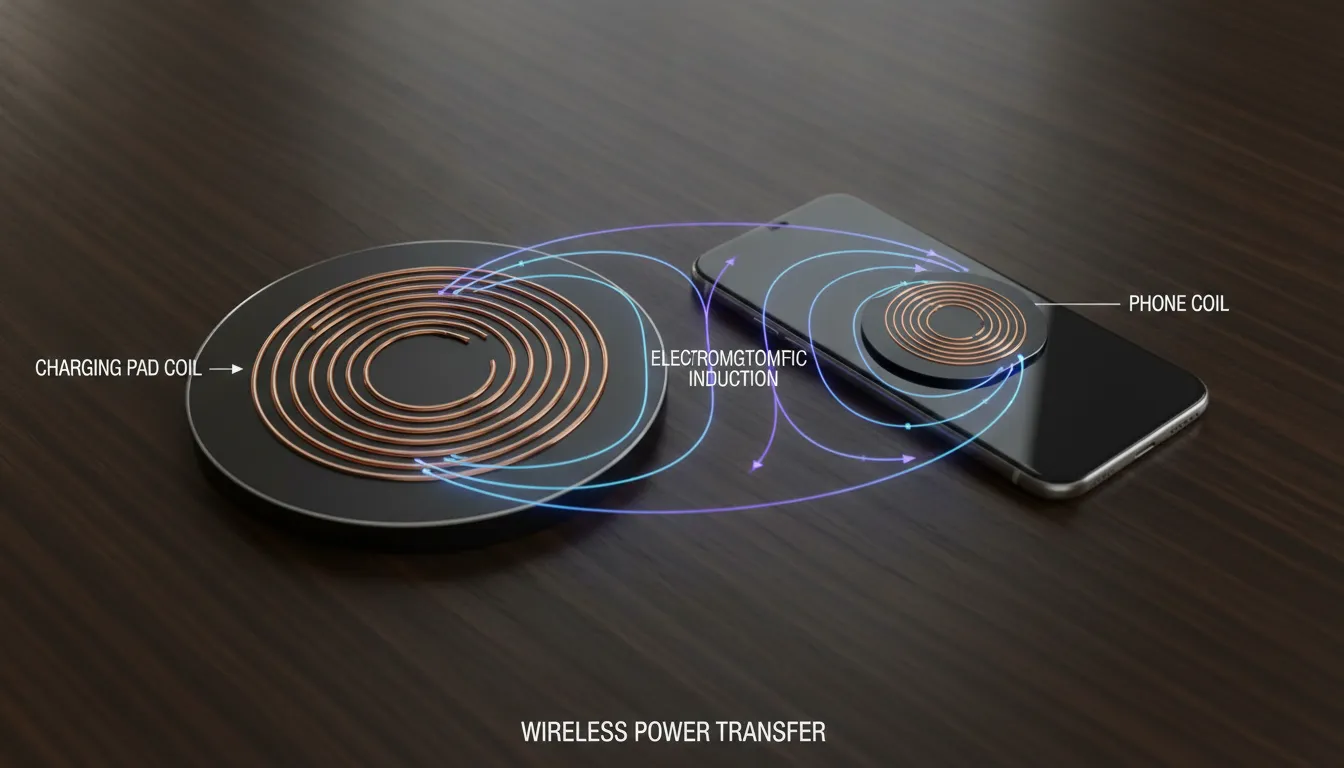
This process was first demonstrated by Michael Faraday in the 1830s. When your device sits on the pad, its coil picks up the magnetic field. The coil then turns that field back into power. This current flows into your battery to charge it up. It is a clean way to keep your setup neat while staying powered. You can use this for any device that has the right parts built inside.
The Qi Charging Standard
Most modern phones and tablets use the Qi standard for power transfer. Developed by the Wireless Power Consortium, Qi ensures that chargers from different brands work with many types of devices. Apple added Qi support to its phones years ago to make charging easier for everyone. This shared system helps you use one station for all your tools. It means you do not need a new cord for every phone you buy.
You can learn more about the growth of wireless charging technology as it gets faster. Newer systems like MagSafe use the Qi standard but add magnets to help with where you put your phone. These magnets make sure the coils line up every time. This helps the charger work at its best without wasting power. Using premium materials like walnut wood or full-grain leather can also help manage the heat that builds up during this work.
Why Distance and Placement Matter
Wireless charging only works over a very small gap. Most chargers need your phone to be within a few millimeters of the pad to work well. If you move the phone too far away, the power flow will stop or slow down. This is why thin cases are better for daily use. Most stations work through cases that are less than 5mm thick.
Good placement is the key to a fast charge. If the coils do not line up, the charger can get warm and lose speed. Using a stand or a magnetic mount helps you find the right spot. This makes it easy to set down your phone and know it will be ready when you need it. Check out our guide to the Qi2 standard and MagSafe differences to see how newer tech solves these issues for Apple users.
How Does Wireless Charging Work? A Step-by-Step Look
To understand the full picture, it helps to look at the core physics that make cord-free power possible. The process starts when a charging station is plugged into a wall outlet. Inside the station, a copper coil receives alternating current, which flows back and forth rapidly. This back-and-forth flow creates an alternating magnetic field around the coil. When a compatible device is placed on the station, a second coil inside the device enters this magnetic field. The field induces an electric current in the receiver coil through a principle called mutual inductance. That current is then converted into direct current to charge the device's battery.
This is the same underlying principle that powers everything from electric toothbrushes to medical implants. The key difference in consumer charging is that Qi-compliant devices typically operate at frequencies between 87 and 205 kilohertz. These higher frequencies allow efficient power transfer through the short air gap between the pad and the device.
The efficiency of this transfer depends heavily on coil alignment. Research from the IEEE shows that lateral misalignment of more than 10mm can reduce transfer efficiency by more than 30 percent, which is why proper positioning matters so much. This is where Apple's MagSafe technology made a breakthrough by embedding a ring of magnets around the receiver coil. When the phone gets near a MagSafe charger, the magnets pull it into perfect alignment. This solves the positioning problem that plagues standard Qi pads and ensures consistent, efficient charging every time.
Qi vs. MagSafe: What Is the Difference?
To understand how does wireless charging work, you first need to look at the two main ways it happens today. Standard Qi charging has been the basic way to power up phones for many years. MagSafe is the newer, faster way made by Apple. Both systems use a small coil in the charger to send power to a coil in your phone. But how those two coils connect makes a big difference in how well your phone charges and how fast it gets full.

The Magnetic Alignment Advantage
The biggest problem with older chargers is where you place the phone. If the two coils do not line up well, you lose a lot of power. In fact, standard Qi pads can experience significant efficiency drops when the coils are even slightly off-center. This loss of energy often turns into heat. Heat is bad for your battery and can make charging much slower over time. It can even age your battery faster if the phone stays too hot for a long time.
MagSafe fixes this problem by using a ring of strong magnets. These magnets pull your phone into the perfect spot every time you set it down. You do not have to guess or check your screen to see if it is charging. This smart setup keeps the coils matched up perfectly. It means you get the most power with the least amount of waste. It also helps your phone stay cool, which is better for the life of your device.
Comparing Qi and MagSafe
This table shows how the two systems match up for your Apple devices and other gear.
| Feature | Standard Qi | Apple MagSafe |
|---|---|---|
| How it lines up | Manual placement | Magnetic snap |
| Top speed | 7.5W (on iPhone) | 15W (on iPhone) |
| Device support | Most smartphones | iPhone 12 and newer |
| Heat level | Higher due to misalignment | Lower and more stable |
| Ease of use | Must check position | Snap and go |
Charging Speed and Device Support
Standard Qi charging on an iPhone is usually capped at 7.5 watts. This is fine for a slow charge while you sleep. But if you need to top off your battery fast before you leave the house, it can feel too slow. MagSafe can reach 15 watts on most recent iPhone models. That is twice as much power as the older standard. By choosing a premium MagSafe station, you can cut down on the time your phone spends on a stand.
MagSafe is not just about raw speed, though. It also works with many new cases and wallets. Standard Qi pads can be picky about case thickness. If your case is too thick, the power will not reach the phone. MagSafe magnets are strong enough to work through premium leather or wood cases that are built for the task. This makes it the best pick for a clean, organized desk or bedside table. It turns a simple task into a smooth, refined part of your day.
Also, MagSafe is a smart system. It talks to your phone to make sure it is safe. It can slow down the charge if the phone gets too warm. This extra step helps keep your gear safe from harm. While Qi is a great base, MagSafe is the premium choice for anyone using an Apple setup at home or in the office. For more on choosing between them, see our guide to the best MagSafe charging stands.
Is Wireless Charging Safe for Your Phone Battery?
A common concern about wireless charging is whether it harms battery health over time. The short answer is that modern wireless charging is safe when you use quality equipment. The main factor that affects battery longevity is heat, and premium charging stations manage heat well through intelligent power management and quality components.
NYTSTND charging stations include multiple safety features to protect your devices. Overheating protection automatically reduces power if temperatures rise. Foreign object detection stops charging if a metal object is between the pad and your phone. Overcurrent protection prevents power surges from reaching your device. These systems work together to keep charging safe and stable.
The perception that wireless charging damages batteries comes from early, low-quality chargers that lacked these safeguards. Those older chargers would generate excess heat because they had poor coil alignment and basic thermal management. Today, any Qi-certified charger from a reputable brand includes the necessary protections. Premium stations actually run cooler than their budget counterparts because the magnetic alignment is precise and the materials help dissipate heat.
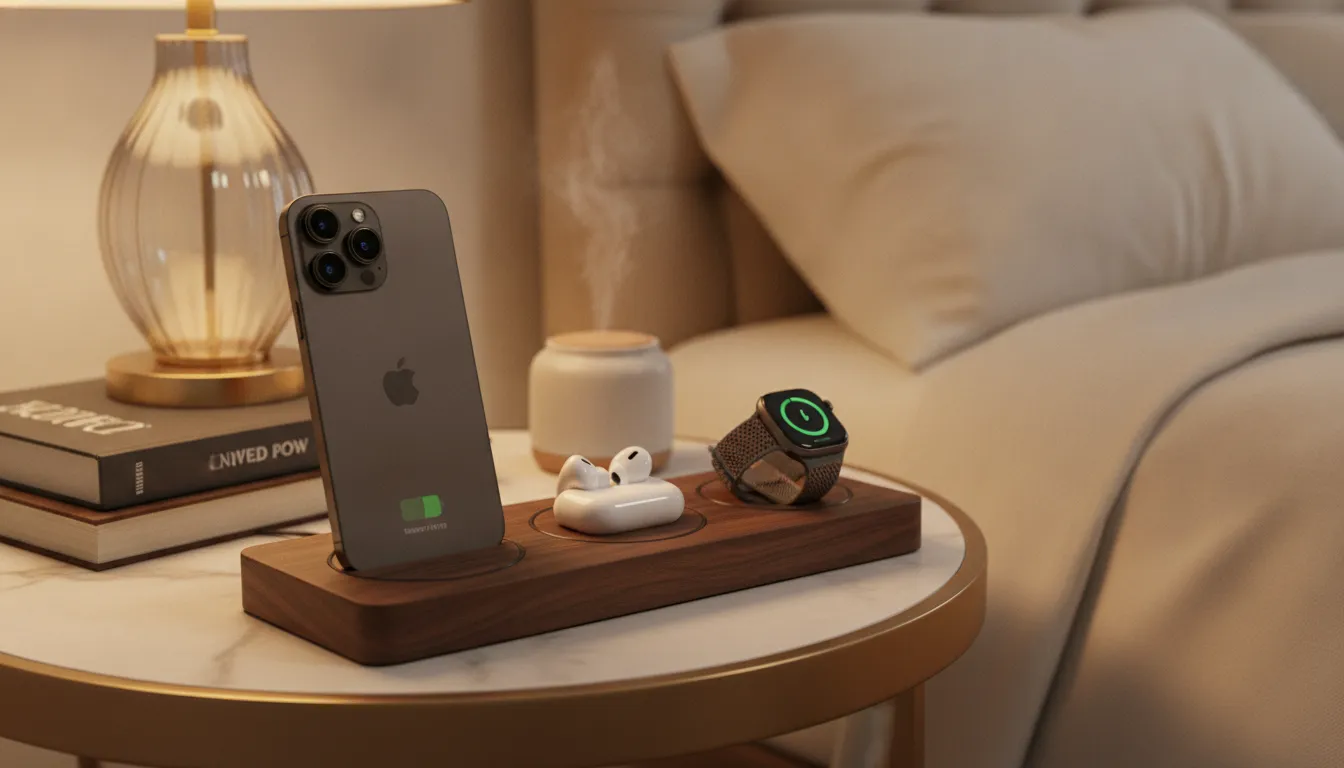
For the best battery health, use a charging station that aligns your phone properly every time. Magnetic alignment systems like MagSafe ensure the coils are perfectly positioned, which minimizes heat generation. This means your phone charges at the optimal speed without unnecessary thermal stress on the battery.
What Does the Future of Wireless Charging Look Like?
The wireless charging industry is moving toward faster speeds, wider compatibility, and deeper integration into everyday furniture. The most significant development is Qi2, the next-generation standard from the Wireless Power Consortium. Qi2 adopts Apple's MagSafe magnetic alignment as its core specification, bringing the snap-and-charge experience to Android phones and other devices. This means the range of magnetic accessories will expand far beyond just Apple products.
Charging speeds are also increasing. While 15 watts is the current standard for phones, the Qi2 specification supports up to 15 watts for handheld devices with the potential for higher power levels in future revisions. Some manufacturers are also working on multi-device charging surfaces that can power a phone, watch, and earbuds simultaneously without individual charging pads.
Another emerging trend is furniture-integrated charging. Instead of a standalone pad on your nightstand, future furniture may embed charging coils directly into nightstand surfaces, desk surfaces, and even countertops. This would eliminate the need for any visible charging hardware while keeping your devices powered whenever they are set down. For Apple users who value clean, minimalist spaces, this represents the ultimate expression of form meeting function.
As wireless charging technology continues to mature, the distinction between a charging station and a piece of furniture will blur. Premium materials like handcrafted walnut wood and full-grain leather are already being used in high-end charging stations to complement home decor. This trend toward beautiful, functional charging solutions aligns with how design-conscious consumers want their living spaces to look and work.
Frequently Asked Questions
Does wireless charging work through phone cases?
Yes, most wireless chargers work through phone cases that are less than 5mm thick. Thicker cases, especially those with metal components or credit card slots, may block the magnetic field and prevent charging. MagSafe chargers can work through slightly thicker cases due to their stronger magnetic connection.
Why is my wireless charger slow?
Slow charging is usually caused by poor coil alignment, a thick case, or using a standard Qi pad instead of a MagSafe charger. Check that your phone is centered on the pad and that your case is wireless charging compatible. Using a 15W MagSafe charger with an iPhone 12 or newer will give you the fastest speeds.
Can I leave my phone on a wireless charger overnight?
Yes, modern phones and smart charging stations are designed for overnight charging. Once the battery reaches 100 percent, the charger stops sending power. Many iPhones also use optimized battery charging that learns your routine and delays charging past 80 percent until just before you wake up.
Does wireless charging use more electricity than wired?
Wireless charging is slightly less efficient than wired charging, typically around 70-80 percent efficiency compared to 90-95 percent for wired. This means it uses a small amount of extra electricity. However, for most people, the convenience of simply placing a phone on a pad far outweighs the minimal energy difference.
Can I wireless charge my AirPods and Apple Watch?
Yes, most recent AirPods cases support Qi wireless charging. The Apple Watch uses its own magnetic charging standard that works with Apple's charging puck and some third-party stations that include a dedicated watch charger module. Multi-device stations from NYTSTND support all three devices simultaneously.
Find Your Perfect Wireless Charging Setup
Understanding how does wireless charging work helps you make a better choice for your home or office setup. The technology has matured to the point where it is faster, safer, and more convenient than ever. Whether you choose a standard Qi pad for basic charging or a premium MagSafe station with handcrafted materials, the key is matching the technology to your daily habits.
For Apple users managing multiple devices, a dedicated multi-device charging station offers the best experience. Magnetic alignment ensures consistent charging every time, and premium materials like walnut wood and full-grain leather turn your charging station into a natural part of your home decor. With features like overheating protection, foreign object detection, and optimized power management, today's wireless charging stations are built to keep your devices safe while they power up. Ready to simplify your daily charging routine? Browse NYTSTND's premium wireless charging collection and find the station that fits your life.
Previous article


