


What Is Qi Wireless Charging? A Complete Guide

Ready to upgrade your setup? Browse NYTSTND's premium wireless charging collection featuring handcrafted wood and leather multi-device stations.
What Is Qi Wireless Charging?
Qi (pronounced "chee," from the Chinese word for energy flow) is the open, universal standard for wireless power transfer. Created by the Wireless Power Consortium in 2008 and released as Qi version 1.0 in 2010, it is the most widely adopted wireless charging standard in the world, backed by more than 350 member companies including Apple, Samsung, Google, Sony, and Xiaomi.
The name was chosen by the WPC to evoke the concept of an invisible flow of energy, and the standard lives up to that promise. Instead of plugging a cable into a port, you set a compatible device down on a Qi charger and it starts receiving power through the surface. The charger detects when a device is present, negotiates the right power level, and delivers energy safely.
How Qi Became the Global Standard
Before Qi, device makers used proprietary wireless charging methods. Nokia Lumia phones had their own chargers, and early Palm devices used a touchstone system that worked only with Palm hardware. Each was a dead end. Consumers had no reason to invest in a technology that would not work with their next phone.
The WPC changed that by creating a single, open specification. Any manufacturer can build Qi into a device or a charger, and any Qi-certified device works with any Qi-certified charger. That interoperability is what made the standard take off. By 2017, Qi had been built into more than 200 smartphone models. Today, it is the assumed baseline: if a phone supports wireless charging at all, it supports Qi.
Qi Certification Matters
Qi certification is not a marketing label. It is a testing and compliance program that ensures safety and interoperability. A Qi-certified charger has passed tests for foreign object detection (the ability to stop charging when a metal key or coin is on the pad) and thermal management to prevent overheating. Non-certified chargers can run hot and, in some cases, damage devices. The Qi logo on a product means it has been independently verified to meet the standard's safety requirements.
How Does Qi Wireless Charging Work?
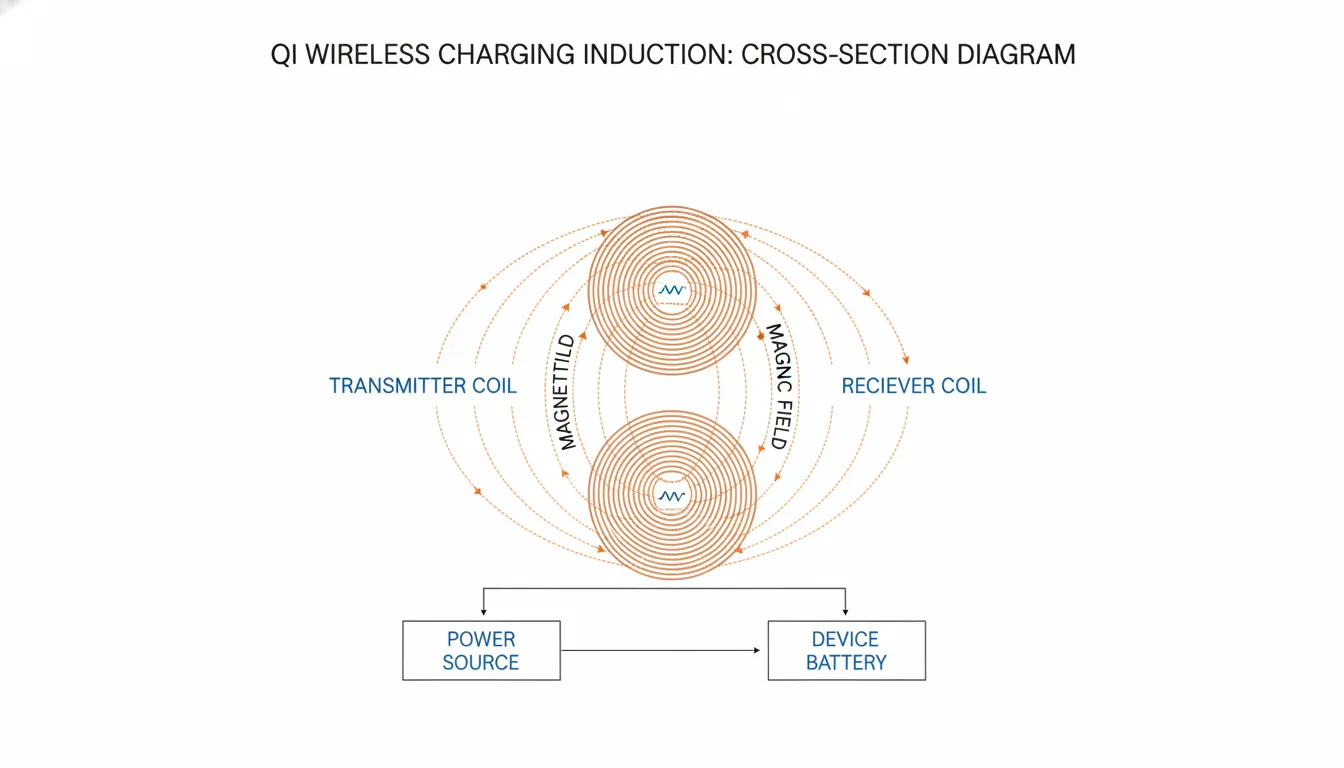
Qi charging works through a physics principle called electromagnetic induction. The process is surprisingly simple and involves just two main components.
Step 1: The Transmitter Coil Creates a Magnetic Field
Inside every Qi charging pad is a copper coil. When the pad is plugged into power, an electric current runs through that coil and creates an alternating electromagnetic field around it. Think of it as a low-power radio transmitter, except its signal is tuned for energy transfer, not data.
Step 2: The Receiver Coil Catches the Field
Your phone contains a matching receiver coil built into the back of the device. When you place the phone on the charging pad, the two coils form a magnetic couple. The alternating field from the transmitter induces an electric current in the receiver coil. This is induction, the same principle that powers an electric stove or charges an electric toothbrush.
Step 3: Energy Converts Back to DC Power
The induced alternating current flows through a rectifier circuit inside your device that converts it to direct current, which is what the battery needs. The device's charging management system then delivers that power at the correct voltage and speed. The effective range for Qi charging is about 4 cm (1.6 inches), though efficiency drops past about 2 cm. That is why placing your phone directly on the pad or through a thin case gives the best results.
Smart Safety Features
Qi-certified chargers include several automatic safety systems:
- Foreign object detection cuts power immediately if a loose item such as a coin or key sits on the pad.
- Thermal management monitors temperature on both the charger and the device side and reduces power if things get warm.
- Power negotiation happens before charging starts, so a low-power earbud case is never hit with the full wattage meant for a phone.
- Alignment feedback signals when your device is positioned correctly for optimal charging.
Qi vs MagSafe: What's the Difference?
This is the most common question about wireless charging today. Qi and MagSafe are not competitors. MagSafe is Apple's implementation of Qi with an important addition: magnets.
| Feature | Standard Qi | MagSafe (Apple Qi) | Qi2 (Next Gen) |
|---|---|---|---|
| Alignment method | Manual placement | Magnet ring snaps into place | Magnet ring (standardized) |
| Max iPhone charge speed | 5W to 7.5W | 15W | Up to 25W |
| Device compatibility | Any Qi-certified device | iPhone 12-16 plus Qi devices | Qi2 and legacy Qi devices |
| Adopted by | 350+ WPC members | Apple only | All WPC members |
A standard Qi pad charges an iPhone at up to 7.5W. A MagSafe charger uses its built-in magnets to snap the phone into perfect alignment and delivers a consistent 15W. The magnets also hold the phone in place, so an incoming call or a gentle bump does not break the connection.
The key point: every MagSafe charger is also a Qi charger. You can charge any Qi-compatible device (Samsung Galaxy phones, Google Pixels, AirPods) on a MagSafe pad. And a standard Qi pad will charge a MagSafe iPhone, just at the lower 7.5W speed.
NYTSTND's charging stations, such as the TRIO 3-in-1 charging station, are designed with MagSafe compatibility for iPhone 12-16 users while also supporting any Qi device on their auxiliary charging positions.
What Is Qi2 Wireless Charging?
Qi2, announced by the Wireless Power Consortium in late 2023 and rolling out in products through 2024 and 2025, is the next generation of the Qi standard. Its defining feature is a built-in magnetic alignment ring, adopted directly from Apple's MagSafe design.
Why Qi2 matters: With standard Qi, users have to line up their phone on the charger by feel. Sometimes the alignment is off by a few millimeters, and the phone charges slowly or does not charge at all. Qi2 fixes that by standardizing the magnet ring so every Qi2 charger and every Qi2 device snaps into perfect alignment automatically. This means no more waking up to a phone that barely gained charge because it shifted overnight.
Qi2 also raises the power ceiling to 25W, up from the 15W that was the effective maximum for fast Qi charging. That translates to noticeably quicker top-ups for compatible devices. And because it is a WPC standard, not a proprietary Apple feature, any phone maker can build Qi2 into their devices. The Qi specification version 2.2, released in April 2025, formalized these improvements, and version 2.2.1 (July 2025) introduced the Qi2 25W branding.
Qi2 is fully backward compatible. Every Qi2 charger charges older Qi devices, and older Qi chargers charge new Qi2 devices. The magnetic alignment only works when both sides are Qi2, but the standard's interoperability is preserved across every generation. If you buy a Qi2 charger today, it will work with your current phone and your next one.
For NYTSTND customers, Qi2 means that the TRIO 3-in-1 station and QUAD 4-in-1 charger you already own will continue to charge future Qi2-compatible iPhones and Androids, and upcoming NYTSTND products will support the magnetic alignment that makes placement effortless.
Which Devices Support Qi Wireless Charging?
Qi support is now standard across the smartphone industry. If a phone was made after 2018 and costs more than $300, it almost certainly supports Qi.
- iPhone: Every iPhone from the iPhone 8 onward (2017 to present) supports Qi wireless charging. iPhone 12 through iPhone 16 add MagSafe, which is Qi-compatible plus a magnetic ring for alignment and faster 15W speeds.
- Samsung Galaxy: The Galaxy S6 (2015) introduced Qi. Every Galaxy S, Note, and Z-series since then includes Qi charging. The Galaxy S24 series supports 15W Qi wireless charging.
- Google Pixel: Pixel 3 (2018) and all newer Pixel phones support Qi. The Pixel 8 and 9 series charge at up to 12W on Qi-certified stands.
- Other brands: Sony Xperia (Xperia 1, 5, and 10 series), LG (most models from 2018 on), Huawei (Mate and P series), and Xiaomi flagships all include Qi. The list runs into the hundreds of models.
- Earbuds and accessories: Apple AirPods with wireless charging cases (2019 onward), Samsung Galaxy Buds, Google Pixel Buds, and most premium wireless earbuds charge over Qi. Many fitness watches and smartwatches offer Qi charging as well. NYTSTND's wireless charger collection supports these devices alongside iPhones.
How to check if your device has Qi: Look in Settings > Battery (iPhone) or Settings > Battery and device care (Samsung) for a wireless charging toggle. Check the spec sheet for "Qi-compatible" or "wireless charging capable."
Why Choose a Premium Qi Wireless Charging Station?
A basic Qi charging pad works fine for a single phone. But most Apple users carry three or more Qi-enabled devices: a phone, earbuds, and a watch. Plugging each one in separately with its own cable creates the very tangle that wireless charging is meant to eliminate.
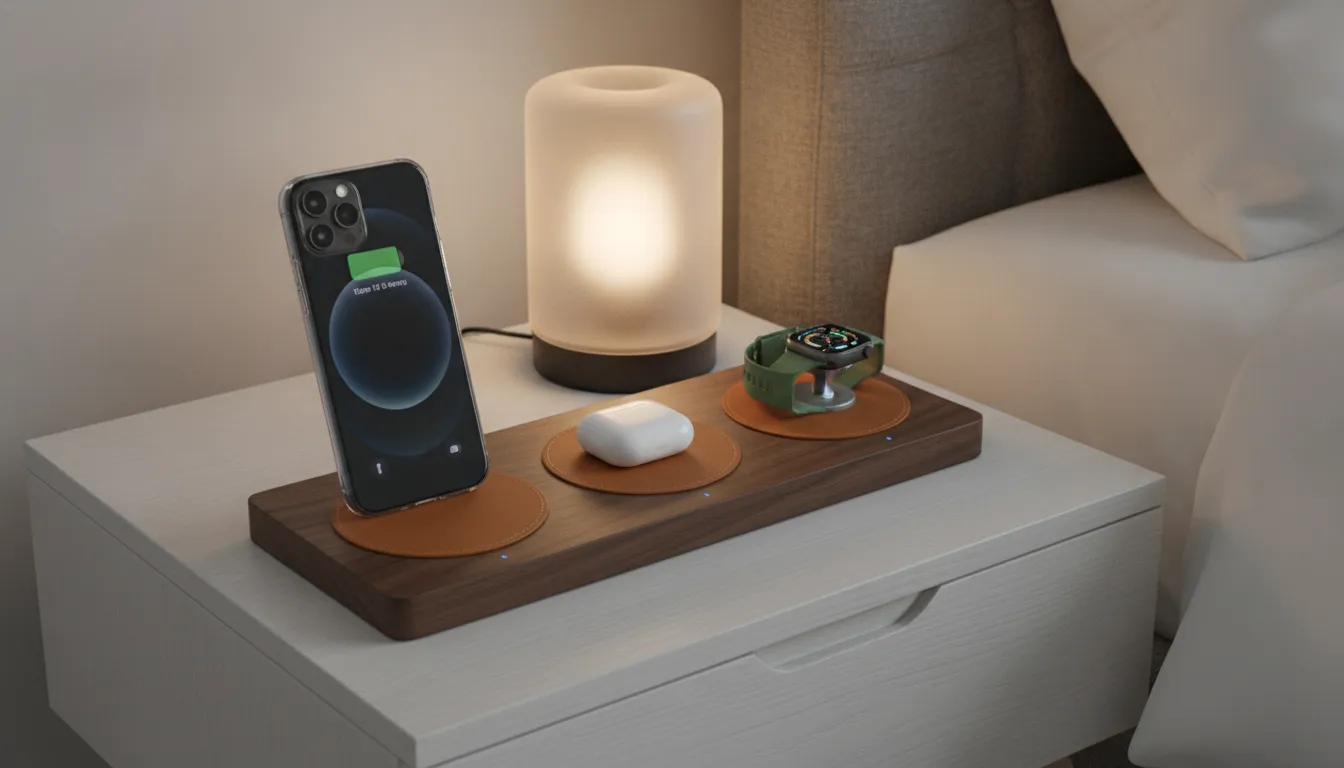
A multi-device Qi charging station changes the experience. You place your phone, drop your AirPods case on the secondary pad, and set your Apple Watch on its spot, all on one surface, all powered by a single cable running to the wall. Your nightstand or desk stays clean. In the morning, everything is charged and ready.
Material quality matters: Most basic charging pads are plastic. They work, but they sit on your nightstand every day and every night. A premium station made from real wood and leather, like the QUAD 4-in-1 charging station from NYTSTND, turns a utility item into part of your room's design. The handcrafted wood base and full-grain leather surface complement the materials already in your home rather than competing with them. Each station is assembled in Ohio by skilled craftspeople, and the natural wood grain means no two pieces look exactly alike.
Organization reduces visual noise: A dedicated charging spot keeps devices in one place. You always know where your phone is. You stop hunting for cables under the bed. Your nightstand becomes a place for a lamp, a book, and your charger, not a tangle of three different cables. This is especially valuable in the bedroom, where reducing visual distractions before sleep can help you wind down more naturally.
Whether you need a compact 2-in-1 DUO station for a nightstand or a full 3-in-1 TRIO charger for the whole family's devices, a premium Qi charging station is an investment in everyday ease. It makes your morning routine smoother and your space calmer, every single day. For those who travel, the TRIO TRAVEL foldable charger packs the same convenience into a portable form factor.
Frequently Asked Questions
How do I know if my phone has Qi?
Check your phone's spec sheet for "Qi-compatible" or "wireless charging capable." On an iPhone, look in Settings > Battery for any wireless charging options. On Samsung, check Settings > Battery and device care. Most phones released after 2018 with a glass back support Qi. If your phone has a metal back, it likely does not, since metal blocks the magnetic field needed for induction.
Are Qi and MagSafe the same?
No. Qi is the open wireless charging standard from the Wireless Power Consortium. MagSafe is Apple's version of Qi that adds a ring of magnets around the charging coil for perfect alignment and faster 15W charging on iPhones 12 through 16. Every MagSafe charger is also a Qi charger, but not every Qi charger provides MagSafe-level speed. The new Qi2 standard brings MagSafe-style magnetic alignment to all devices.
Can I use any charger for Qi charging?
Yes, any Qi-certified charger works with any Qi-compatible device, regardless of brand. Qi certification ensures safety features like overheat protection and foreign object detection. Charging speed will depend on both the charger and the device. A 5W Qi pad charges an iPhone slower than a 15W MagSafe charger, but both will charge the phone safely.
Does Qi charging work through a phone case?
Yes, Qi charging works through most phone cases up to about 3 to 4 mm thick. Thicker cases, cases with metal components, or cases with pop sockets or magnetic grips may interfere. MagSafe-compatible cases include built-in magnets that help maintain alignment. If your phone does not charge through the case, try removing it and see if that fixes the connection.
Is Qi wireless charging bad for battery health?
Qi wireless charging generates more heat than wired charging, and heat is a known factor in battery aging. However, modern Qi chargers and smartphones include thermal management that keeps temperatures in a safe range. For most users, the convenience of dropping a phone onto a pad outweighs the small impact on long-term battery health. Apple and Samsung both design their phones to manage wireless charging heat without issue.
Ready to Upgrade Your Wireless Charging Setup?
Qi wireless charging is the standard for a reason: it is simple, universal, and getting better with every generation. Whether you want a single pad for your phone or a multi-device station for your entire Apple setup, NYTSTND offers handcrafted charging solutions made from real wood and full-grain leather. Explore the full collection and find the station that fits your space.
Previous article

Next article


